
When condition meets variety, the 1988 penny stops being background noise and starts becoming inventory.
A sharp division of assets into two categories with radically different values characterizes the 1988 Lincoln cent market.
Standard coins struck with the RDV-005 die comprise the first group, possessing only the nominal face 1988 penny value.

Transitional specimens featuring the RDV-006 die form the second group, representing significant numismatic interest.
This market gap stems from a technical error by the US Mint, allowing the use of next year's tooling prematurely.
The present analysis examines the financial mechanisms creating a 15,000% price distance between nearly identical objects.
Anatomy of the Price Gap
Professional grading agency data and public auction results confirm the existence of this market gap.
Standard 1988 issues rarely exceed a $5 price point, even in superb condition.
The RDV-006 variety demonstrates a starting value of $150 for certified specimens of average preservation.
Pricing models rely heavily on the factor of confirmed die scarcity.
Indicator | Standard (RDV-005) | Variety (RDV-006) | Gap in % |
Initial Price | $0.01 | $150 | 1,500,000% |
MS65 Grade Price | $10 | $450 | 4,400% |
MS66 Grade Price | $25 | $1,200 | 4,700% |
Auction Liquidity | Low | High | n/a |
Technical Causes of RDV-006 Scarcity
Market shortages of the RDV-006 variety result directly from the disruption of the die replacement schedule in late 1988.
Mint facilities in Philadelphia and Denver began testing new reverse designs before the official start of 1789.
Specimens found in circulation indicate an extremely low number of operating cycles for these transitional dies.
Tool wear led to rapid degradation of fine details, often making identification impossible.
Consequently, the quantity of clearly identifiable RDV-006 coins has remained static for decades.
Differentiation of Design Elements
FG Initials on RDV-005: Absence of a serif on the vertical stroke of the letter G.
FG Initials on RDV-006: Presence of a prominent horizontal crossbar at the top of the G.
Memorial Relief: Smoother lines found on the standard production run.
Letter Clarity: Deep and detailed rendering of symbols on the transitional die.
Yield Analysis and Annual Price Dynamics
Statistics spanning a ten-year period confirm the investment appeal of the 1988 RDV-006 cent.
Heritage and Stack's Bowers auction data record the annual appreciation of these rare specimens.
Average value growth for coins in MS65 RD condition ranges from 5% to 8% per year.
Unlike standard issues, the RDV-006 variety remains resistant to inflationary depreciation.
History of Auction Records (RDV-006)
Sale Year | Lot/Mint Facility | Condition | Price |
2013 | 1988-P | MS66 RD | $440 |
2018 | 1988-D | MS65 RD | $900 |
2021 | 1988-P | MS66 RD | $850 |
2022 | 1988-D | MS66 RD | $2,500 |
Price drops occur only during the mass release of coins from a single private collection to the market.
In 2023, average prices for MS64 grade specimens decreased by 12% due to temporary supply saturation.
Values recovered to previous levels by early 2024, confirming sustained demand.
Search Logistics as an Economic Factor
Extracting profit from 1988 cents requires significant time investment.
Searching through bank rolls remains the primary method for acquiring uncertified inventory.
Probability of locating an RDV-006 in Philadelphia is approximately 1 case per 5,000 inspected coins.
Denver Mint probability drops significantly to 1 case per 15,000 units.
Considering time costs, the hourly rate of a searcher often exceeds the potential profit from low-quality finds.
Mint Location | Mintage (Billions) | RDV-006 Scarcity | Investment Risk |
Philadelphia | 6.08 | Moderate | Low |
Denver | 5.25 | High | Medium |
Impact of Metal Composition on Asset Preservation
Condition of the copper plating over the zinc core critically affects the market gap.
Zinc corrosion penetrating through micro-cracks in the copper destroys numismatic value within months.
Most RDV-006 coins found in circulation carry Brown (BN) or Red-Brown (RB) ratings.
Market divide between Red (RD) and Brown (BN) classes reaches 80% of the asset's value.
Price Gradation by Copper Color
RD (Red): Base market price of $450 for MS65.
RB (Red-Brown): Market price of $270 for MS65.
BN (Brown): Market price of $90 for MS65.
Protective capsule usage is mandatory for preventing asset degradation.
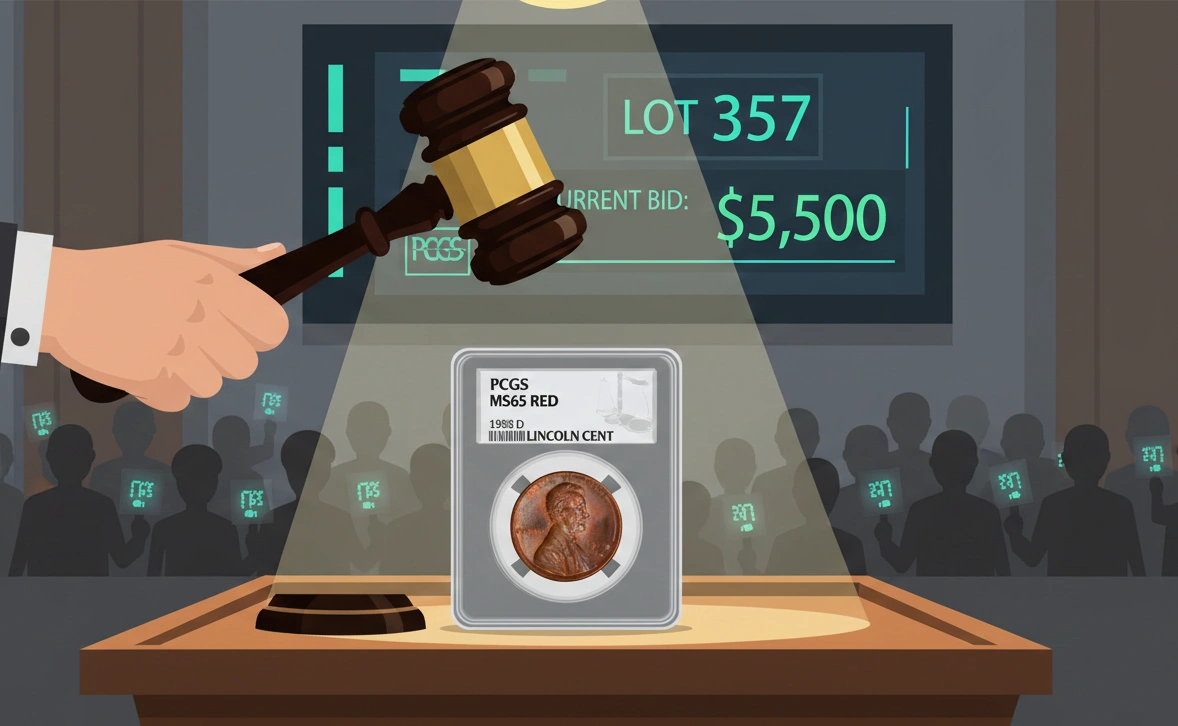
Role of Professional Grading in Closing the Gap
Certification by PCGS or NGC companies transforms uncertain risk into a liquid commodity.
Without official variety confirmation, the RDV-006 coin trades at a 50-70% discount.
Open market buyers require guarantees of die authenticity and condition accuracy.
Cost Structure for Legalizing a Find
Grading fee: $35.
Variety attribution fee: $20.
Postage and insurance: $15.
Auction platform commission: 15% of price.
Net profit from selling an MS63 RD coin after all expenses totals approximately $25-35.
For MS66 RD specimens, net profit can exceed $1,000.
Factors Changing the Market Landscape
Implementation of high-resolution digital microscopes changed the search dynamics for RDV-006.
Previously hidden details became accessible to the mass searcher, increasing the confirmed population.
Despite population growth, prices for top-tier grades continue to rise.
This trend is explained by an influx of new collectors forming demand for certified rarities.
Market gap between the common cent and the RDV-006 persists due to the impossibility of mass-producing perfect 1988 surfaces.
Market Gap Development Forecast
Analysis of long-term trends points to a further expansion of the distance between common and rare 1988 cents.
Removal of zinc coins from circulation by the US government will lead to the final disappearance of the search base.
In this scenario, the RDV-006 variety will shift from a discovery category to an exclusive auction lot category.
Expected price growth for MS65 RD specimens over the next 5 years is approximately 25%.
The market gap will remain a fundamental characteristic of this year, turning a technical detail into a financial instrument.
Thorough analysis of every 1988 cent allows for capitalizing on the US Mint's industrial error.
Understanding the difference between RDV-005 and RDV-006 dies remains the key success factor in modern numismatics.